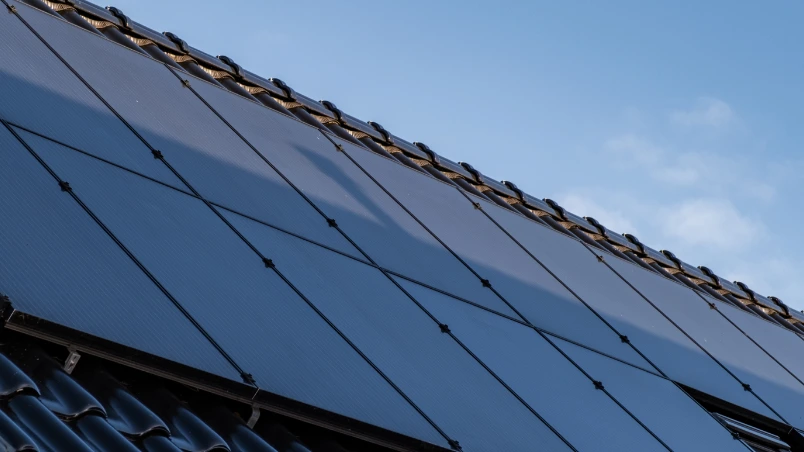
The number of solar panels you need depends on your electricity use and your roof’s expected production. Square footage alone cannot answer the question. Two homes of the same size may use very different amounts of electricity because of air conditioning, electric vehicles, pool equipment, or occupancy.
For a useful first estimate, collect 12 months of electricity use in kilowatt-hours. Then ask a designer to model your actual roof. A monthly dollar bill can start a conversation, but it does not replace usage data.
Step 1: Add your annual electricity use
Find the kWh used on each electricity statement and add the last 12 months. Keep electricity separate from gas, water, and other services. If your home already has solar, utility purchases alone do not show total household consumption; the existing system’s production and self-consumption need review.
For illustration, a home averaging 800 kWh monthly uses about 9,600 kWh annually. Do not assume the same amount every month: summer cooling and seasonal changes can make a monthly average hide important patterns. Download interval usage when available so the proposal can address timing as well as totals.
Step 2: Estimate the production of the proposed roof layout
A solar array’s rated size is measured in kW; its electricity output over time is measured in kWh. A production model combines the array size with roof direction, tilt, weather, shading, and losses. PVWatts provides preliminary generation estimates, while a site-specific design should evaluate the actual property.
Ask for the model inputs. A shaded roof in a Los Angeles neighborhood and an unobstructed roof in Riverside County should not automatically use the same production assumption. Even adjacent roof planes can perform differently.
Step 3: Convert system size into a panel count
Here is a simplified example using assumptions, not a production forecast: suppose the goal is 9,600 kWh annually and the modeled annual yield is 1,500 kWh for each installed kW. Dividing 9,600 by 1,500 gives a 6.4 kW array. If each proposed panel is rated at 400 watts, 6,400 watts divided by 400 watts equals 16 panels.
If the assumed yield were instead 1,200 kWh per kW, the same annual target would imply an 8 kW array, or 20 panels at 400 watts each. This example shows why a panel-count estimate without a production assumption is incomplete. Actual equipment sizes and available layouts will change the design.
Step 4: Include realistic changes to your household
- Electric vehicle: estimate annual driving, vehicle efficiency, and the share charged at home.
- Heat pump or electric water heater: ask for a documented annual-use estimate.
- Pool equipment: review actual schedules and consumption.
- Efficiency improvements: account for planned changes that could reduce demand.
- Household changes: discuss additional residents or extended work-from-home schedules.
Separate confirmed plans from possibilities. Ask for a current-use design and a future-use scenario with each added load shown. This makes it easier to see what you are paying to accommodate. Confirm any utility sizing requirements before approving a larger array.
Why 100% annual offset does not mean a zero bill
Producing the same annual kWh that your home consumes does not mean production and use occur together. A home may export midday electricity and import at night. Remaining charges and the applicable export-credit rules affect the bill. Compare projected imports, exports, and any storage operation rather than treating annual offset as a savings guarantee.
Frequently asked questions
How many panels does a 2,000-square-foot house need?
There is no reliable panel count based only on floor area. Use annual electricity consumption, a roof production model, and the wattage of the proposed panels.
Should I cover every available roof surface?
Not automatically. Ask the designer to compare the extra cost and expected production of additional panels, especially on shaded or less productive roof planes.
Does adding a battery reduce the number of panels I need?
A battery stores energy; it does not create it. Its charging needs, losses, and intended use should be included in the system model.
Explore solar panels and battery storage and our solar FAQs before reviewing a layout.
Want to understand the options for your property? Request a free solar assessment. Los Angeles Solar Advisory helps homeowners in Los Angeles, Riverside, and Ventura counties explore solar options through consultations representing Axia by Qcells. Your proposal should reflect your home, utility, and contract terms.